Nelson-Denny Practice Test 2026: vocabulary, passages and the reading-rate minute
Take a free Nelson-Denny practice test: 16 vocabulary words and one timed passage on two clocks, at the pace of the real Nelson-Denny Reading Test, starting part 2 with the one-minute reading rate. Then prepare both parts with lesson videos, timed drills and full simulations.
- 12 video lessons and written guides for vocabulary, comprehension and the reading-rate minute
- 27 timed drills at test pace, every answer explained, the trap named
- A diagnostic and 6 full simulations in the 36- and the 38-question layout, with an extended-time mode
- Four extra lessons on the rest of police hiring: psych evaluation, background, medical, polygraph
Applying to a police department that tests reading with the Nelson-Denny? For the other written tests, see all our police exam prep.
- 16 words and 1 passage with 5 questions
- 3:00 + 2:40 on two clocks, the real pace
- Includes the reading-rate minute
- Score by part and question type, every answer explained
Free · no account, no email · questions from the course, not items from the real test
Take a look inside Nelson-Denny 2026
A short tour: the lesson videos, the guides, the vocabulary and reading drills, the trainers and the simulations.
Two parts and a reading rate. What the Nelson-Denny measures.
The Nelson-Denny Reading Test has a vocabulary part and a comprehension part, plus a reading rate taken at the start of part 2.1,3 Which form you get, G/H or I/J, is up to the department or testing center, so ask them.
Vocabulary
Vocabulary items with five answer choices
- Forms G/H80 items, five options each1, 15 minutes2*
- Forms I/JFive options; the publisher pages do not give the item count3
- Pace80 words in 15 minutes is about 11 seconds a word
Comprehension
Reading passages, each followed by questions
- Forms G/H38 questions1 in 20 minutes2*
- Forms I/JSeven passages, 36 questions, five options each3
- Pace38 questions in 20 minutes is about 32 seconds a question, reading included
Reading rate
Taken on the first passage
- Forms G/HAssessed part way through the first passage of the comprehension part1
- Forms I/JOptional: after one minute on passage 1 you mark the last sentence you reached3
- Our practiceThe free test and the course use the one-minute format of Forms I/J. Read at your normal speed.
* Wikipedia and the testing-center page do not name the form for these figures. Wikipedia cites the 1993 manual for Forms G and H, and the figures differ from those of Forms I and J, so this page lists them as Forms G/H.
For Forms I and J the publisher reports grade equivalents, age equivalents, percentile ranks and index scores.3 None of our sources names a passing score. Ask the agency which score, which scale and which form apply to you before you test.
Nelson-Denny test facts at a glance
From the publisher and testing-center pages cited below- What it is
- A timed, multiple-choice reading test with two subtests, vocabulary and comprehension, plus a reading rate.1,3
- Publisher
- Earlier forms: available from Riverside Publishing.1 Forms I and J (2019): PRO-ED, also sold by PAR.3
- Vocabulary, Forms G/H
- 80 items with five answer choices1 in 15 minutes.2
- Vocabulary, Forms I/J
- Five answer choices; the publisher pages do not give the number of items.3
- Comprehension, Forms G/H
- 38 questions1 in 20 minutes.2
- Comprehension, Forms I/J
- Seven passages, 36 questions, five answer choices each.3
- Testing time
- Forms G/H: 35 minutes.2 Forms I/J: 35 to 56 minutes.3
- Which form?
- Sources 1 and 2 do not name the form for their figures (80 items, 38 questions, 15 + 20 minutes). Wikipedia cites the 1993 Forms G & H manual, and the figures differ from Forms I/J, so we list them as Forms G/H.
- Reading rate
- Assessed part way through the first passage of the comprehension part.1 In Forms I/J it is optional: you mark the last sentence read after one minute on passage 1.3
- Scores, Forms I/J
- Grade and age equivalents, percentile ranks and index scores (mean 100, SD 15); vocabulary and comprehension combine into a General Reading Ability composite.3
- Passing score
- Not given in these sources. Our advice: ask the department or school which score, which scale and which form apply to you.
Part 1: eighty words, fifteen minutes
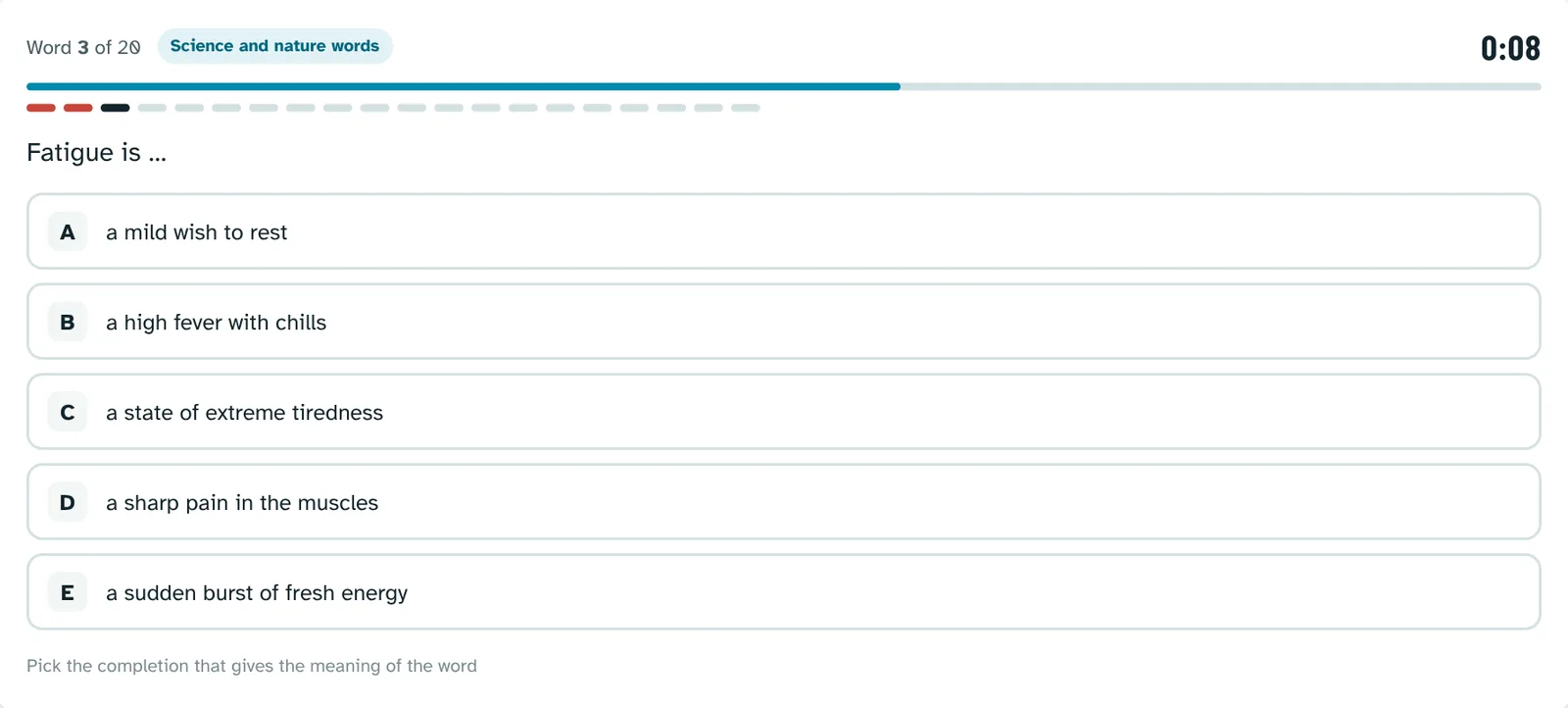
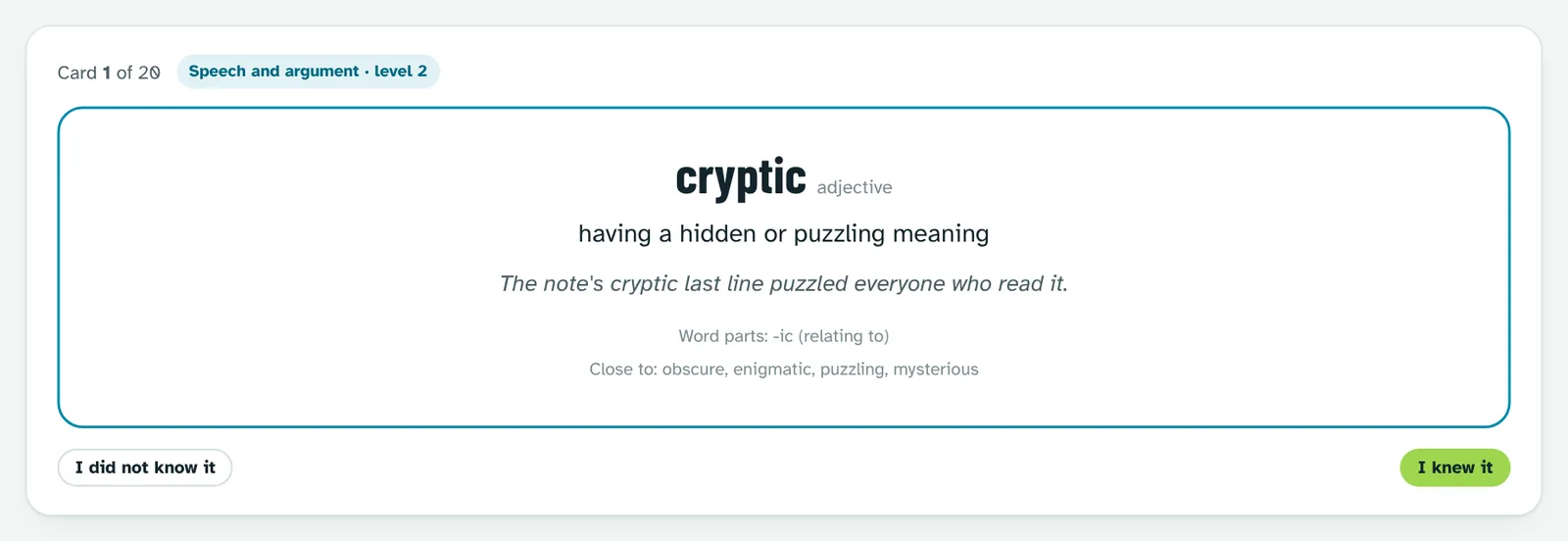
About 11 seconds a word in Forms G and H. Four lessons take the vocabulary part apart. Every drill puts a clock on each word, explains the answer and names the trap you fell for.
Part 2: passages on the clock, and the minute before them
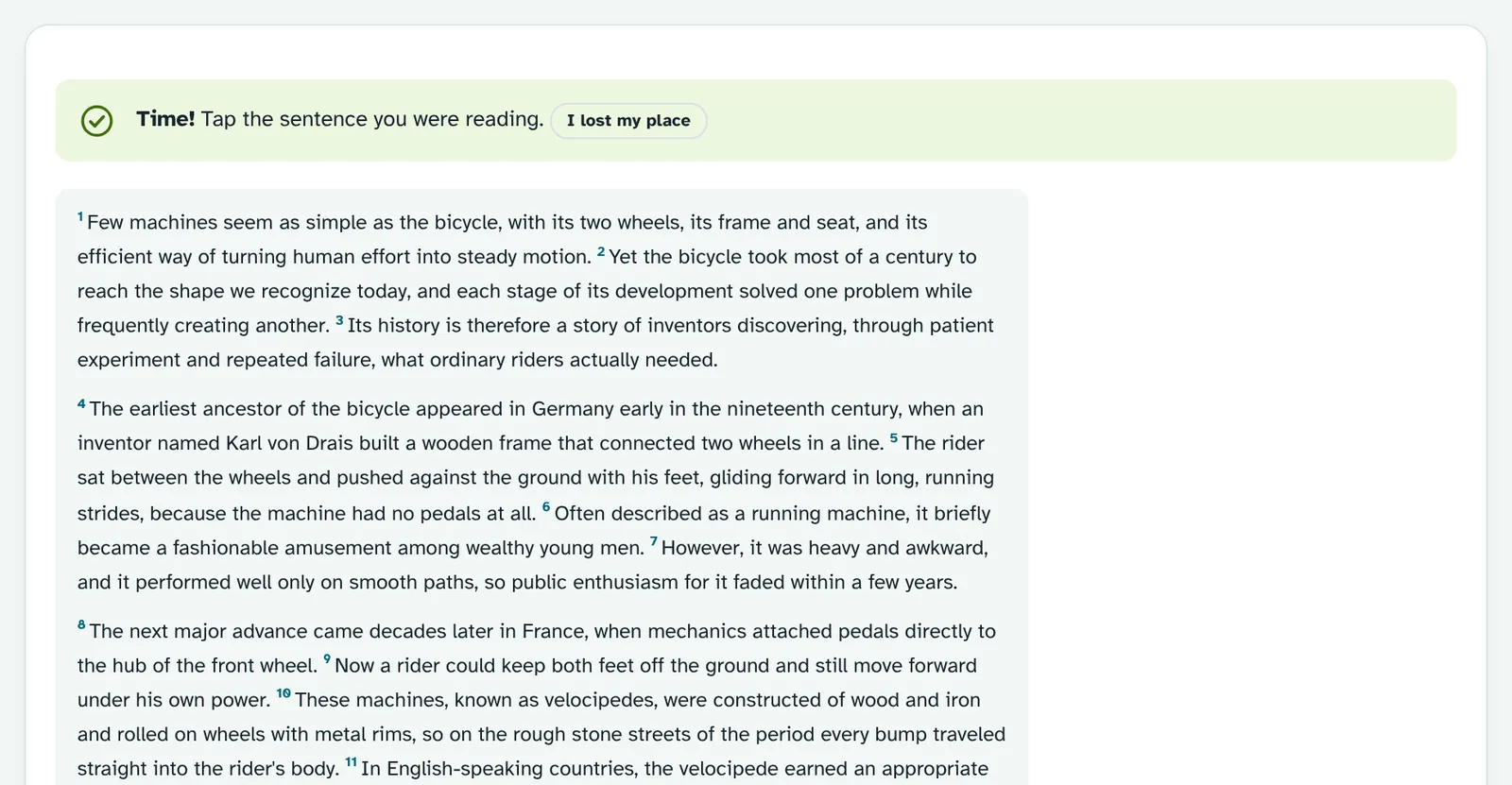
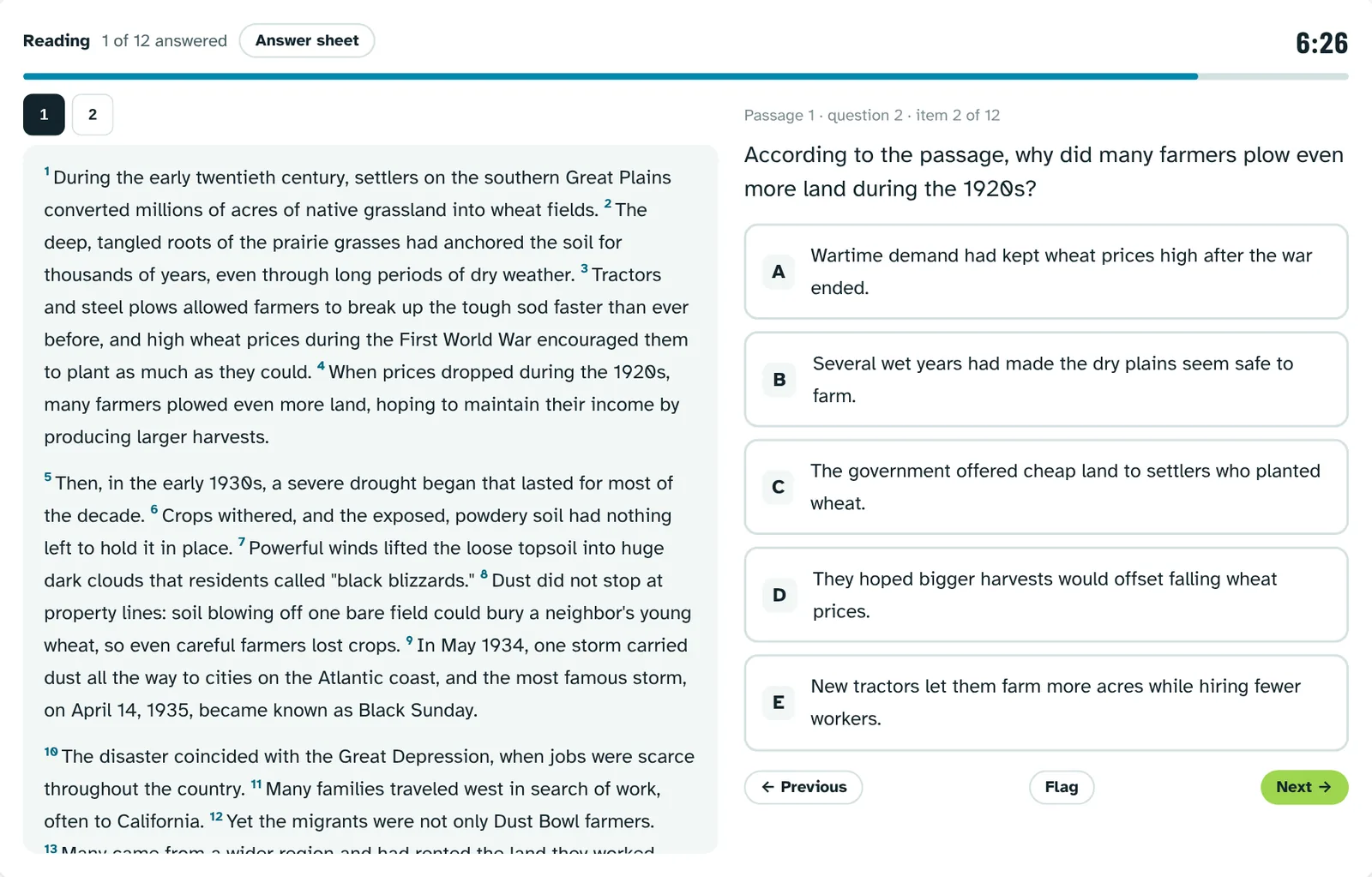
The comprehension part asks what a passage says and what follows from it. Six lessons cover the reading rate, the question types and the pace of a whole part. The reading drills use their own passages, so nothing spoils a simulation.
How every lesson works
Learn the method, see it on an example, then put it on the clock. Same steps in every lesson, so you always know what comes next.
- 1
Watch the lesson
12 video lessons: how the test works, the 35-minute plan, the four vocabulary lessons and the six reading lessons.
- 2
Read the guide
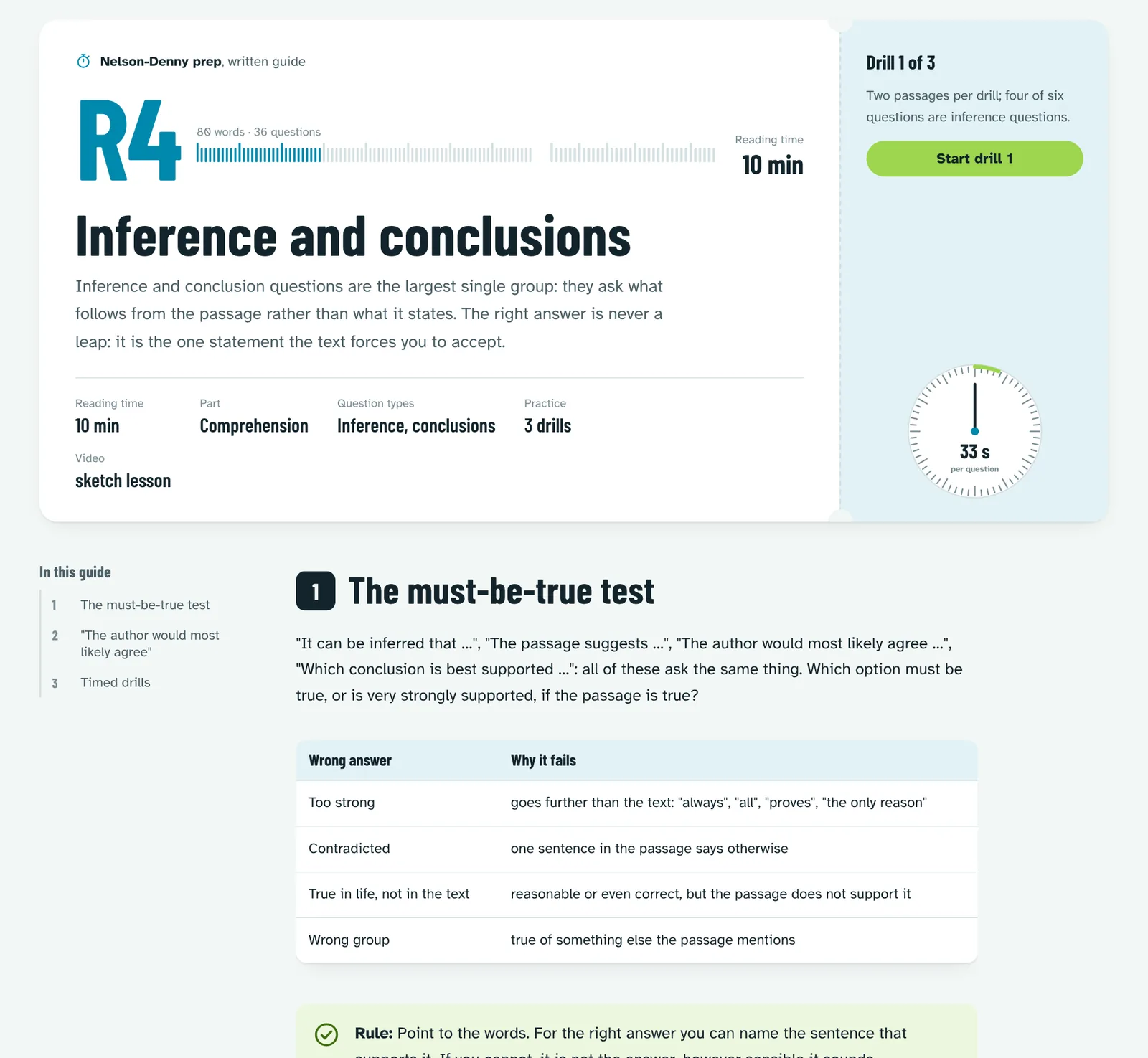
A written guide per lesson with the method, the traps that cost points under time pressure and an example to try.
- 3
Practice without pressure
A trainer in the V1 and V2 guides, word cards in V3 and the rate trainer in R1.
- 4
Drill on the clock
Three drills per lesson, easy, moderate and hard, with the explanation for every answer at the end.
Then the diagnostic and six full simulations show whether the pace holds for 80 words and seven passages.
A diagnostic and 6 full simulations
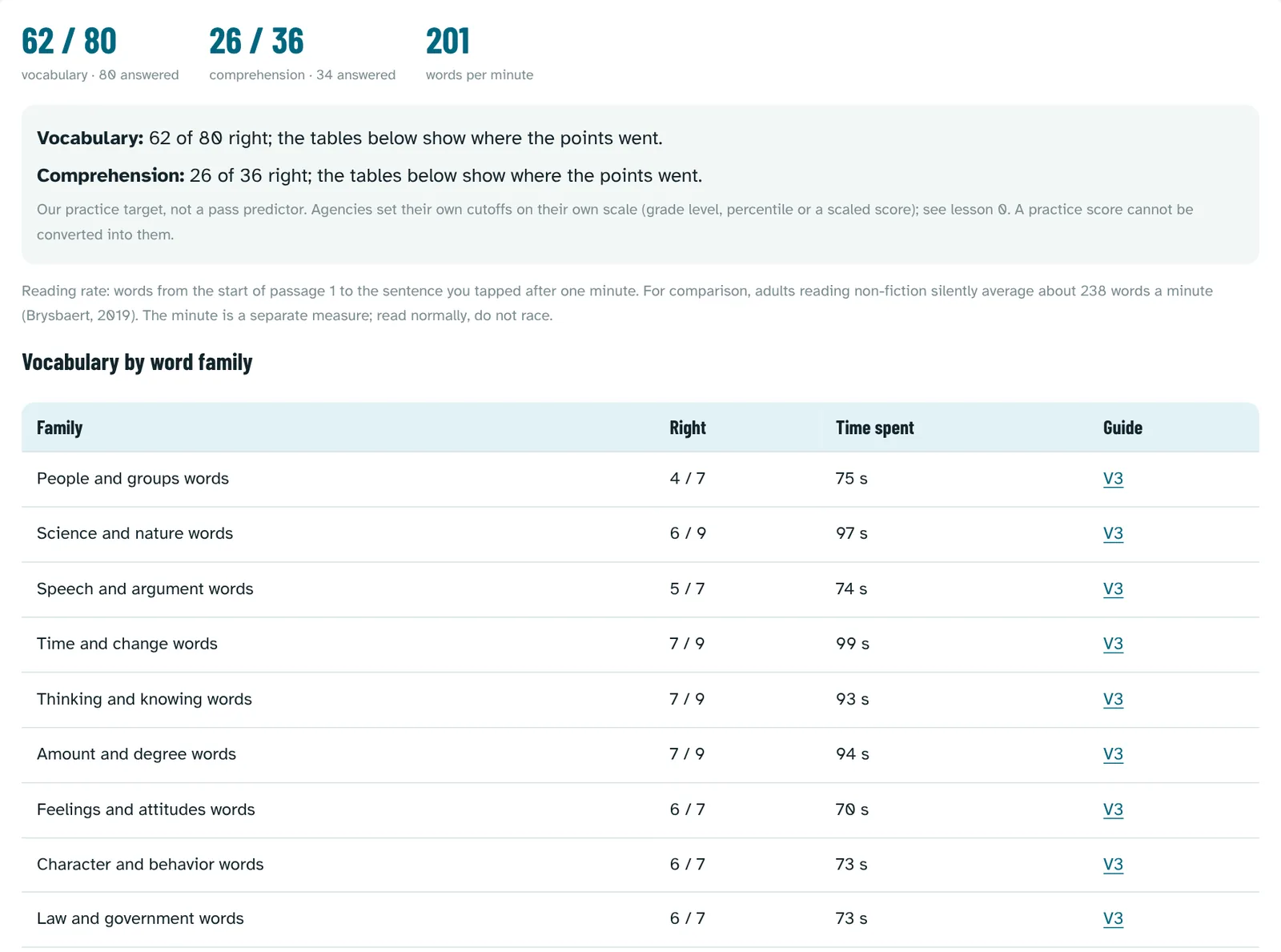
Every form runs like the paper test: two parts, each on its own clock, with an answer sheet to skip, flag and go back inside a part. Part 2 starts with the reading-rate minute. The result shows right answers per part, words per minute, tables by word family and question type, and the lessons to start with.
- DIAGDiagnostic80 words in 15 minutes, then 7 passages with 36 questions in 20 minutes; take it first
- 1–4Simulations 1–436 comprehension questions on 7 passages, as in Forms I/J; vocabulary and clocks modeled on Forms G/H (80 words, 15 + 20 minutes)
- 5–6Simulations 5–680 words and 38 questions in 15 + 20 minutes, as in Forms G/H, with the weighted total
- EXTExtended-time mode60% more time, 24 + 32 minutes, if your agency approved it
The publisher pages for Forms I/J give neither the number of vocabulary items nor the time per part, so the 36-question simulations use the G/H vocabulary part and clocks. The 560 words and the passages of the diagnostic and the simulations appear nowhere else in the course, so every full test is new. Results are practice scores; grade levels and percentiles come only from the publisher’s norm tables.
Free practice vs Nelson-Denny 2026
Free questions show you the format. Here’s what they usually leave out.
| Free practice | Nelson-Denny 2026 | |
|---|---|---|
| Clock | Often untimed | A clock on every vocabulary word, every reading drill and both parts of every simulation |
| Reading rate | Usually skipped | A rate trainer, and the minute at the start of part 2 in every simulation |
| Vocabulary | A short word list | 1,500 words in ten families and three levels, word cards, word parts |
| Passages | One or two | 92 original passages with 483 questions |
| Why an answer is right | Often just a key | Every answer explained; in vocabulary, the trap you picked is named |
| Full-length practice | One test, if any | A diagnostic and 6 simulations in both layouts, with an extended-time mode |
| Cost | $0 | $68 once, 90 days of access |
Your plan, sized to your test date
Three study plans built on the course lessons. Pick how much time you have and see the route.
Seven days: diagnostic first, then your two weakest lessons.
The diagnostic shows where the points go. Put the days into the lessons its result names first.
- Day 1Diagnostic: a full form on the real clocks35 min
- Day 2–4Your two weakest lessons, three drills each, 10 minutes of word cards a day~45 min
- Day 5A full simulation, then 10 minutes of word cards35 min
- Day 6Review the misses~30 min
- Day 7Rest, word cards only10 min
Fourteen days: both parts, then two simulations.
Week 1 builds the methods, week 2 puts them on the clock.
- Week 1Diagnostic, then V1, V2, R2, R3 and R4 with their drills; word cards every daydaily
- Week 2V4 sprints, R5, R6, two simulations three days apart, then review the missesdaily
Thirty days: every lesson and all six simulations, the last two days before the test.
Twenty minutes every day beats three hours on a Sunday, especially for vocabulary.
- Week 1Diagnostic, lessons 1, V1, V2 and R1–R3daily
- Week 2V3 with daily word cards, R4, R5daily
- Week 3V4 and R6 sprints, simulations 1 and 2daily
- Week 4Simulations 3 to 5, weak lessons again; simulation 6 two days before the testdaily
Everything in the course
17 lessons: how the test works and your plan, four vocabulary lessons, six reading lessons, the simulations and four lessons on the rest of police hiring, each with a short self-check. 12 of them come with a lesson video.
After the reading test
The Nelson-Denny is usually one step of police hiring. These guides cover the steps around it.
Questions before you buy
Is this a free Nelson-Denny practice test?
Yes. The practice test on this page is free, with no account and no email: 16 vocabulary words in 3 minutes, then one passage with 5 questions in 2 minutes 40 seconds, starting with the one-minute reading rate. That is the pace of Forms G and H, about 11 seconds a word and about 32 seconds a reading question. You get your score for each part, your words per minute and an explanation for every answer. The questions come from our course; they are not items from the real test.
What is the Nelson-Denny test?
The Nelson-Denny Reading Test is a timed, multiple-choice test with two subtests, vocabulary and reading comprehension, plus a reading rate. If a police department uses it to screen applicants, ask which score it requires. Earlier forms are available from Riverside Publishing; the newer Forms I and J (2019) are published by PRO-ED and also sold by PAR.
How many questions are on the Nelson-Denny Reading Test?
It depends on the form. The figures usually given for the older forms, which we take to be Forms G and H (the sources do not name the form), are 80 vocabulary items with five answer choices each and 38 comprehension questions. Forms I and J have seven reading passages with 36 comprehension questions, five answer choices each; the publisher pages for Forms I and J do not give the number of vocabulary items.
How long is the Nelson-Denny exam?
A university testing center gives 35 minutes of testing time: 15 minutes for vocabulary and 20 minutes for comprehension; it does not name the form, and the figures match the older Forms G and H. For Forms I and J the publisher gives 35 to 56 minutes of testing time. Either way the clock is tight: 80 words in 15 minutes is about 11 seconds a word.
How does the reading-rate minute work?
The reading rate is assessed during the first passage of the comprehension part. In Forms I and J it is optional: after one minute on passage 1 you mark the last sentence you reached. The free test on this page and every simulation in the course use this one-minute format at the start of part 2. Read normally: the questions on that passage come right after, from the same text.
Which form will I take, G/H or I/J?
That depends on the department or testing center, so ask them, and ask how long you get and which score you need. The older forms, G and H, are usually described with 80 vocabulary items and 38 comprehension questions in 35 minutes. Forms I and J (2019) have seven passages and 36 comprehension questions and take 35 to 56 minutes. The course has simulations in both layouts: four with 36 questions and two with 38.
What is a passing score on the Nelson-Denny?
None of the sources on this page names a passing score. For Forms I and J the publisher reports grade equivalents, age equivalents, percentile ranks and index scores with a mean of 100. Ask the department or school that tests you which score it requires, on which scale and on which form. A practice score cannot be converted into these scores, because they come from the publisher’s norm tables.
Is the Nelson-Denny test hard?
The hard part is the clock and the range of words: in the older format, 80 words in 15 minutes is about 11 seconds a word, and 38 questions in 20 minutes is about 32 seconds a reading question, reading included. Practicing both parts on the clock is what the course is built for.
Is there a Nelson Denny practice test PDF with answers?
We do not offer a PDF or the official test. The free Nelson-Denny practice test on this page is online, and you see every answer with an explanation at the end. The course adds 27 timed drills, a diagnostic and 6 full simulations, all with explanations.
Is there a Nelson-Denny vocabulary word list?
No list can promise the exact words on your form. The course has a lexicon of 1,500 words in ten meaning families and three levels: 940 of them appear in the drills and the word cards, which bring back the words you miss; the other 560 are kept for the diagnostic and the simulations, so those stay new. Lesson V2 adds the prefixes, roots and suffixes that help with words you have never seen.
Can I get extended time?
Ask the agency or school whether extended time is available to you. The publisher gives 35 to 56 minutes of testing time for Forms I and J. The course simulations have an extended-time mode with 60% more time (24 + 32 minutes), for candidates who have been approved for it.
What do I get, and how fast?
One payment of $68 gives you 90 days of access to Nelson-Denny 2026: 12 video lessons, 17 written lessons, 27 timed drills, word cards, a reading-rate trainer, a diagnostic and 6 full simulations, plus four lessons on the rest of police hiring. Access starts right after checkout. If it is not right for you, email support within 7 days for a full refund (7-day money-back guarantee).
Is Prepterminal affiliated with the publisher?
No. Prepterminal is independent test prep and is not affiliated with, endorsed by or sponsored by PRO-ED, PAR, Riverside or any police department. Nelson-Denny Reading Test is a trademark of its owner. All words, passages and questions are written by us in the format of the real test.
Everything for both parts of the Nelson-Denny
- 12 video lessons and 17 written lessons, 4 of them on the rest of police hiring
- 27 timed drills: 9 vocabulary drills, 3 vocabulary sprints, 12 reading drills, 3 passage sprints
- A 1,500-word lexicon: 940 words in drills and word cards, 560 kept for the full tests
- 92 original passages with 483 questions, every answer explained
- A reading-rate trainer, a diagnostic and 6 full simulations, with an extended-time mode
- Results by part, word family and question type, with the lesson to open next
Eighty words. Seven passages. Practice the pace first.
Take the diagnostic tonight and see whether the words, the passages or the clock cost you the most points.
Get Nelson-Denny 2026: $68P.S. Not ready to buy? Take the free practice test first, then decide.
7-day money-back guarantee

