Police Exam Prep 2026: find your test, then train for it
There is no single police exam. Each agency or state picks its own written test, from California’s PELLET-B to New York City’s DCAS exam, and they differ in parts, length and scoring.1,7 Take a free 12-question police practice test on the skills most of them share, then let Police Prep 2026 open the path for the exact test your agency uses.
- Test finder: pick your state and agency, or your test by name1 min
- The format guide for your test, with a lesson video5–8 min read
- Simulation 1: your diagnostic in your test’s format1 h 30–3 h
- Skill units in the order of your test3–4 drills or questionnaires each
- Simulation 2: check your progressbefore test day
- 12 questions on five shared skills
- 15:00, about 75 seconds each
- Writing, reading, words, math, reasoning
- Score by skill, every answer explained
Free · no account, no email · practice items written for our course
See Police Prep 2026 before you buy
A short tour: the test finder, a path, a drill and a simulation report. Then take the free practice test above.
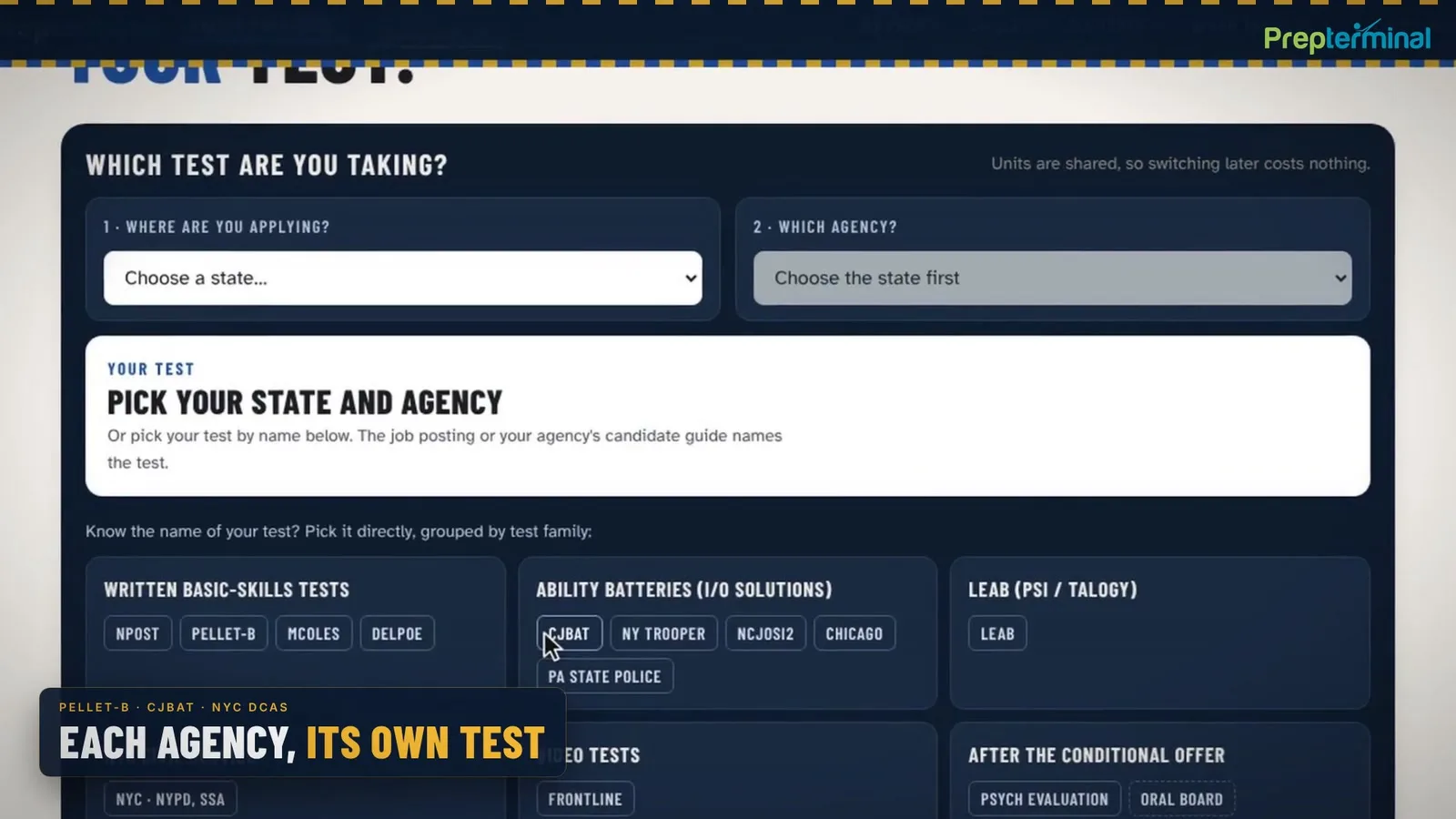
Course trailer · Police Prep 2026, one course for 13 police tests
Which police exam will you take?
The one your agency names in its job posting or exam notice. A state may require one test for every academy, as Michigan and Florida do; in California most agencies use the PELLET-B, while some choose another test. Elsewhere each department may choose its own, as with the NPOST.1,2,3,4,14 The table lists the written tests Police Prep 2026 has a path for; most test pages have a free practice test in that test’s style.
| Test | Who uses it | What it covers | Free practice test |
|---|---|---|---|
| NPOST (Stanard) | Agencies that choose it, under slightly different names2 | Arithmetic, reading, grammar, report writing: 75 items in four timed parts2 | NPOST practice test |
| PELLET-B (California POST) | California police and sheriff agencies1 | Clarity, spelling, vocabulary, reading; a T-score, each agency sets its cut1 | PELLET-B practice test |
| MCOLES Reading and Writing | Michigan, before academy enrollment3 | Reading and writing; item count and time not published3 | MCOLES test |
| CJBAT (FDLE) | Florida academies, law enforcement and corrections versions4 | 97 items in 90 minutes, behavioral and memorization sections included; pass or fail4 | CJBAT practice test |
| LEAB (PSI/Talogy) | Massachusetts municipal and MBTA police, Delaware State Police5,18 | Ability test plus two questionnaires in one sitting5 | LEAB practice test |
| Massachusetts Civil Service police exam | Municipal and MBTA Transit Police candidates6 | The LEAB; 70 on the ability test to pass6 | Massachusetts state police exam |
| NYPD Police Officer exam (DCAS) | New York City Police Department7 | Nine abilities, memorization and maps included; 70 % to pass7 | NYPD exam |
| School Safety Agent exam (DCAS) | NYC School Safety Agents, exam 73248 | The same nine abilities as the Police Officer exam8 | School Safety Agent exam |
| NY State Trooper exam (IOS) | New York State Police9 | 65 cognitive and 85 personality items, separate clocks9 | NY State Trooper exam |
| NCJOSI2 (IOS) | Agencies that choose it, e.g. the Missouri State Highway Patrol10,11 | 80 cognitive items, 120 behavioral statements10 | NCJOSI2 practice test |
| Chicago Police Officer exam | Chicago Police Department, at Pearson VUE12 | 89 behavioral items, then 61 cognitive items12 | Chicago police exam |
| PA State Police (Guardian Selection Inventory) | Pennsylvania State Police cadets13 | Behavioral sections, a cognitive section and situational judgment13 | In the course (PA State Police path) |
| FrontLine National (NTN) | Agencies such as San Francisco14 | Video scenes, reading, incident report writing14 | In the course (FrontLine path) |
| DELPOE (Darany) | Kaua‘i Police Department, Hawaii15 | Memory of a drawing, writing, reading, a background questionnaire15 | DELPOE exam |
| Psychological evaluation | Agencies, typically after a conditional offer16 | Questionnaires and an interview with a psychologist16 | Police psychological exam |
What is on a police exam?
Reading and language items are on every written test in the table above. Most add reasoning (rules, patterns, errors on a form, the order of steps), several add memory or visual items, and many add a questionnaire about how you work. None of them tests police knowledge: the answers come from what is on the page or the screen.1,2,5,7,9 Math is the exception rather than the rule: arithmetic is one of the NPOST’s four parts,2 so check your test before you spend weeks on it.
Police exams at a glance (2026)
Checked October 26, 2026 against the guides in the sources- Who picks the test
- The state or the agency, not a national body. Michigan requires the MCOLES test and Florida academies the CJBAT; California agencies mostly use the PELLET-B; elsewhere each department chooses.1,2,3,4
- Shared skills
- Reading and language items in every written test above; reasoning in the LEAB, the NYC exams and the I/O Solutions batteries; memory in the CJBAT and the NYC exams.4,5,7,10
- Questionnaires
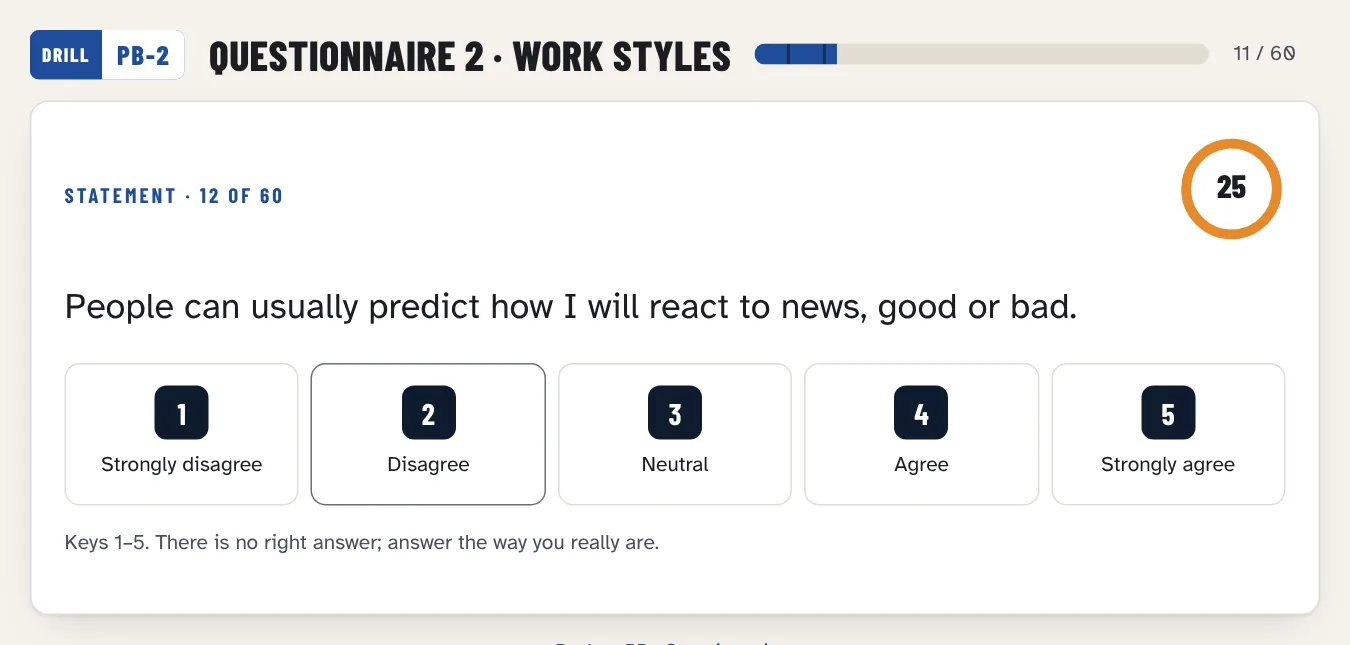
- Part of the CJBAT, the LEAB, the NY Trooper exam, the NCJOSI2 and the Chicago exam: statements rated on an agreement scale.4,5,9,10,12
- Pass marks
- They differ: 70 % on the NYPD exam, 70 on the Massachusetts ability test, an agency-set T-score cut on the PELLET-B, pass or fail with an unpublished cut on the CJBAT.1,4,6,7
- Calculator
- Not allowed on the NPOST (current guides), the NYPD exam, the NY Trooper exam and the Chicago exam.2,7,9,12
- Ranking
- Several lists rank passing candidates by score, so a higher score can mean an earlier call, e.g. NYC and Massachusetts.6,7
- After the written test
- Typically an oral board, a background investigation, at many agencies a polygraph, then a conditional offer followed by a psychological evaluation. Our course guides describe each step.16,17
Which skills do police exams test?
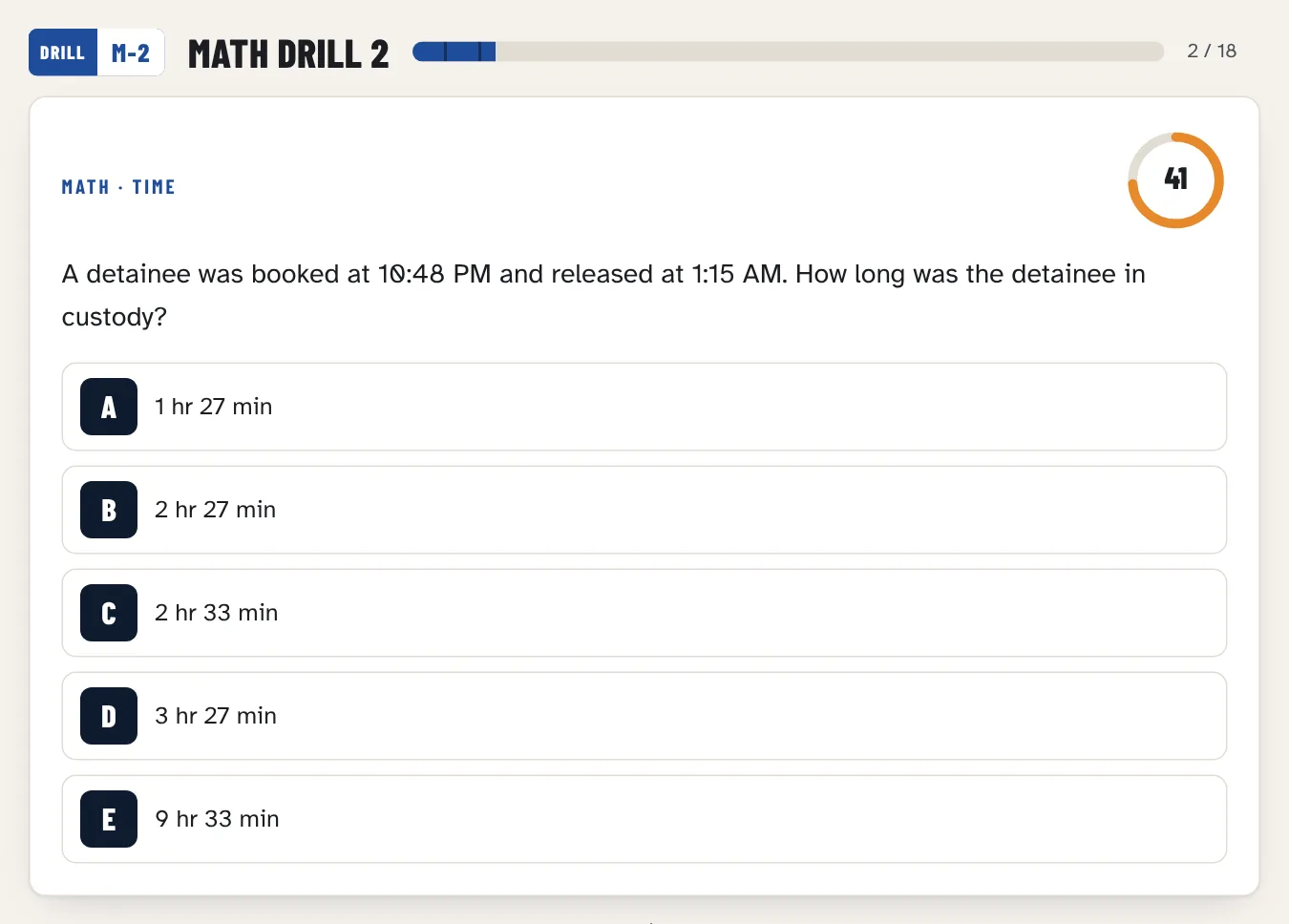
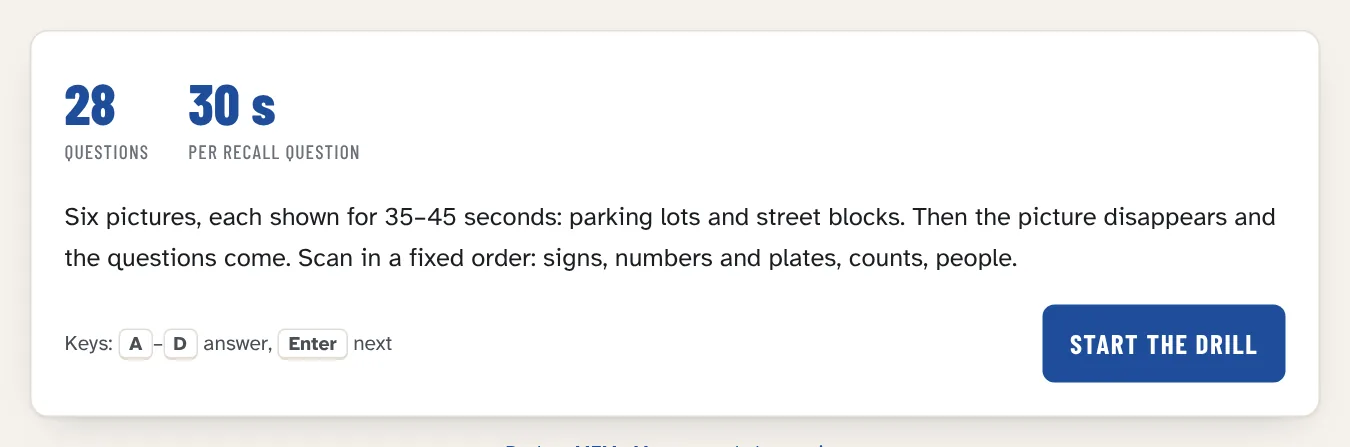
Four groups of skills, in different mixes. The course trains each in its own unit, and every path uses the units its test needs, in the test’s order, so practice for one agency carries over to the next.
How does Police Prep 2026 work?
One course, 13 paths. You tell the test finder which test you are taking, and the course opens that path: the format guide first, a diagnostic simulation, the units in your test’s order, a second simulation before test day.
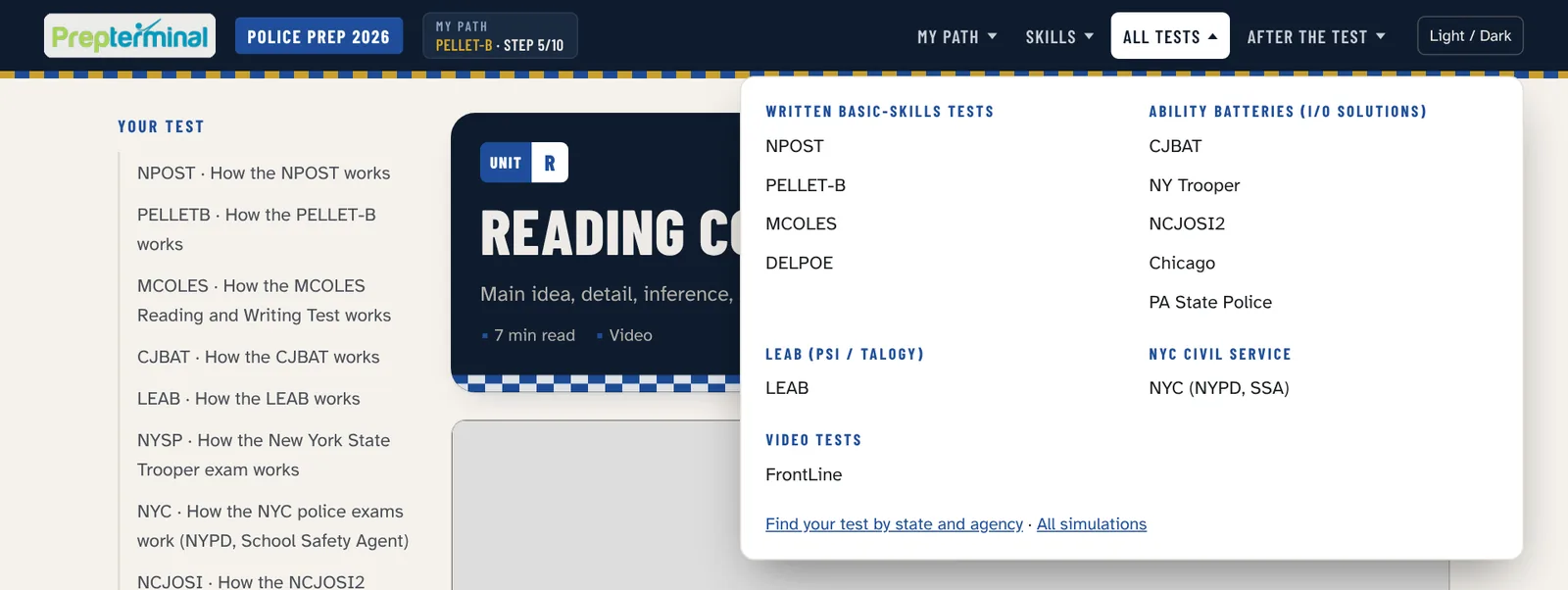
- 1Test finder
Your state, your agency, your test
Pick your state and agency, or the test by name. The course opens the matching path and remembers it. Applying to several agencies? Switch paths at any time.
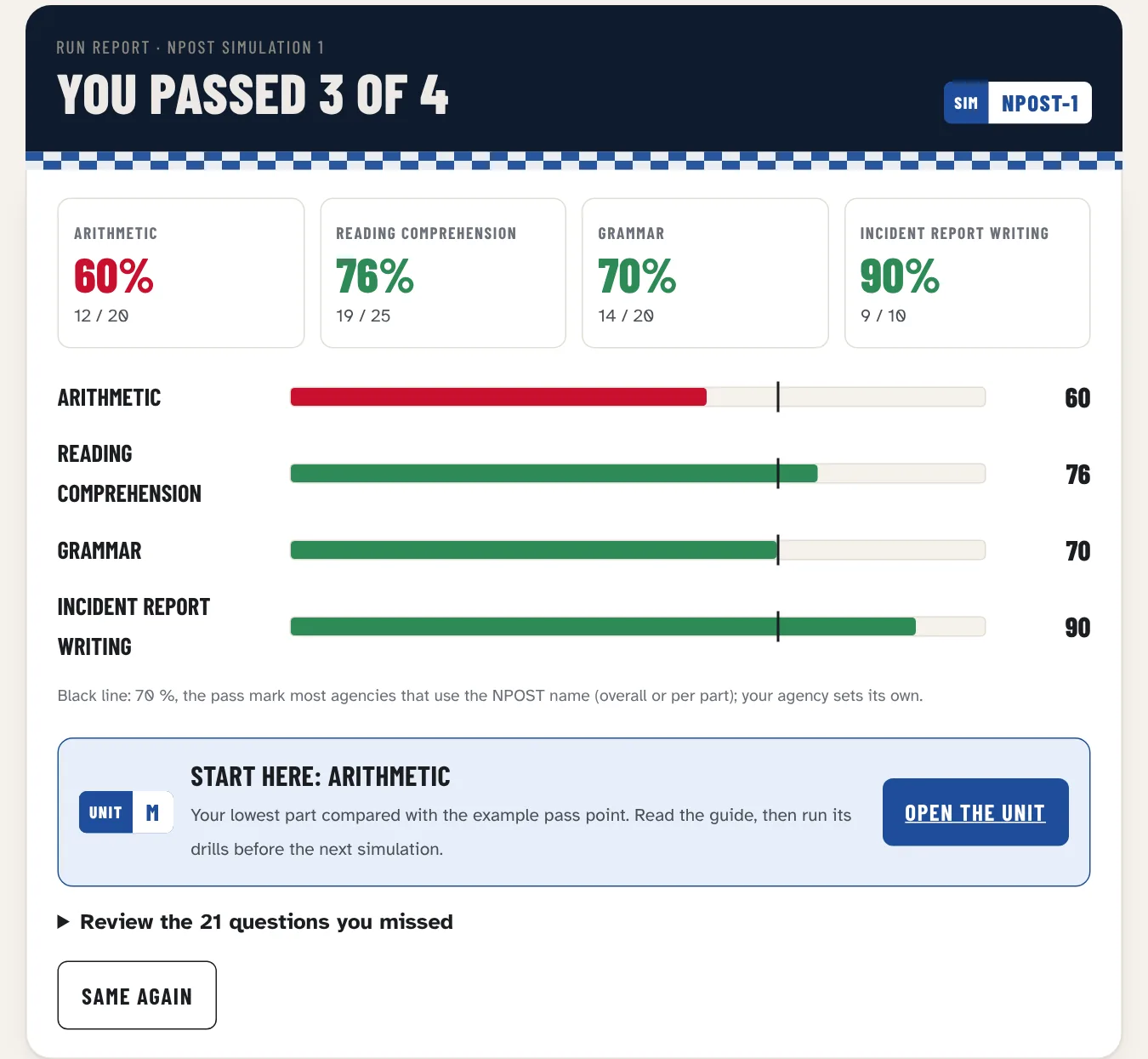
- 2Simulation 1
In your test’s format
Take it cold, before you study. The report scores each part, lists every miss with its explanation and names the unit to start with.
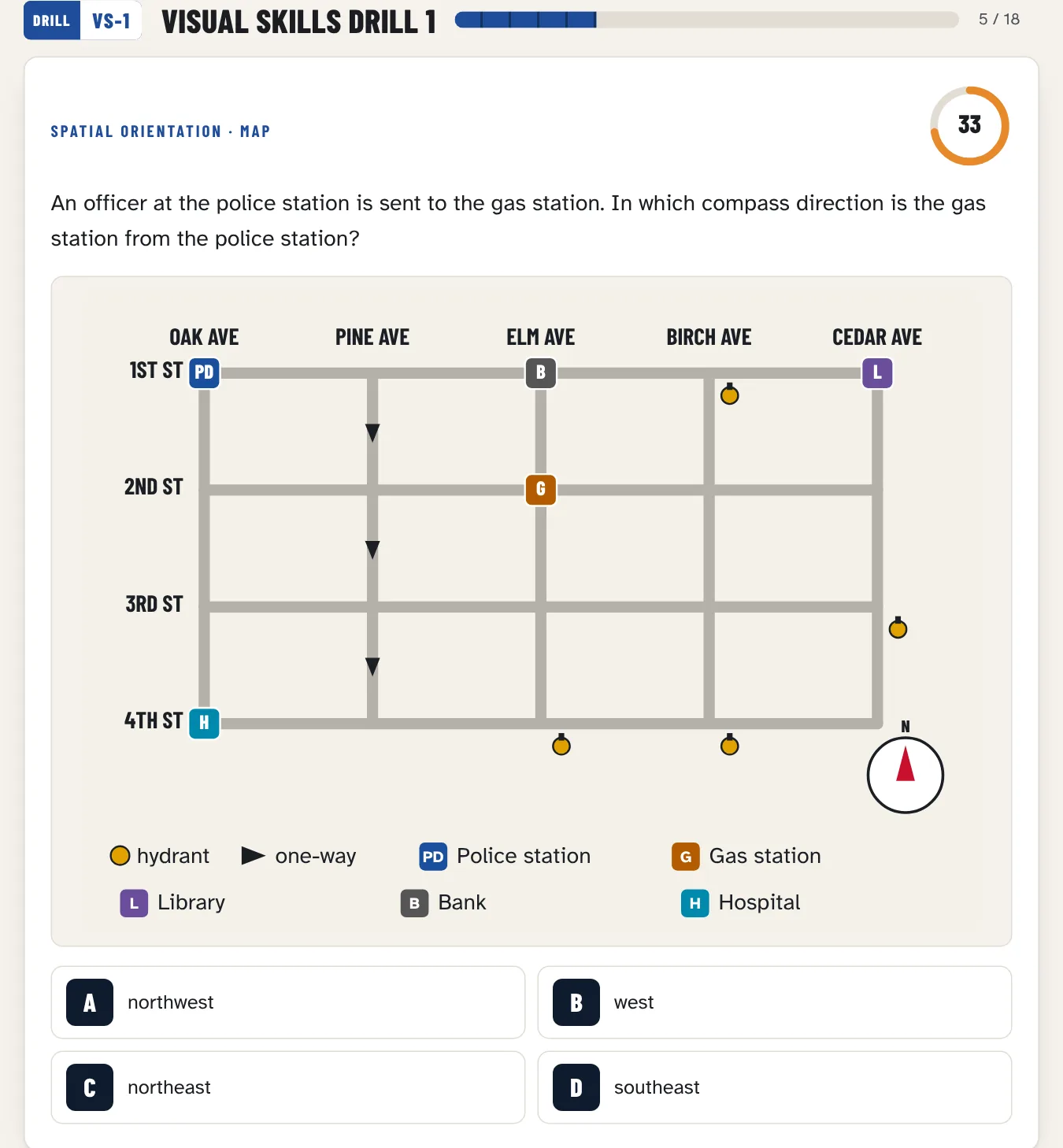
- 3Skill units
3–4 drills each
Each unit has a short guide and lesson video, then drills from easy to hard, timed except the questionnaires. Explanations appear right after each answer.
- 4Simulation 2
A few days before test day
Compare it part by part with Simulation 1. Then read the guides for the steps that follow: oral board, background, polygraph, psych evaluation, fitness test.
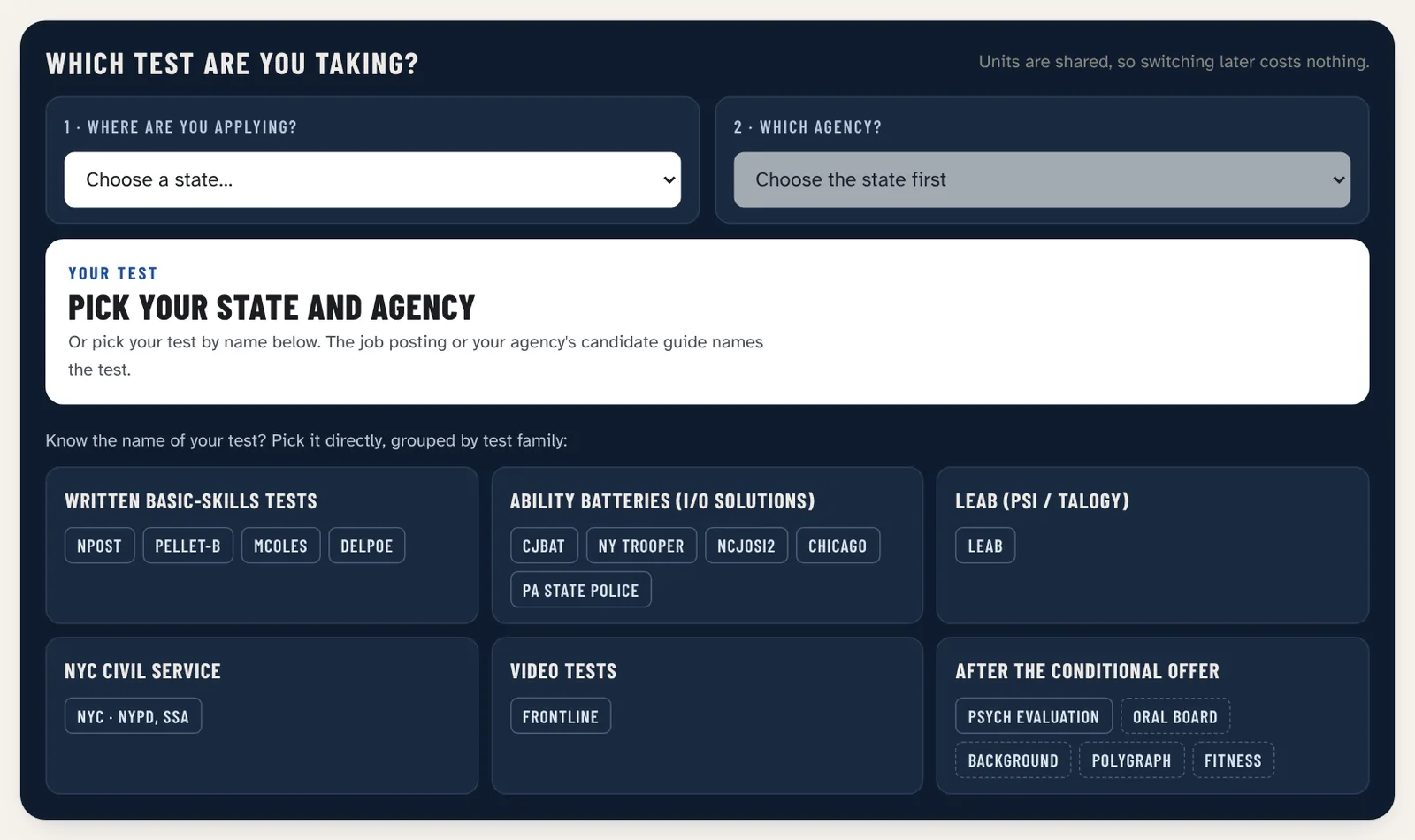
The 13 paths
Twelve written tests and the psych evaluation. Not sure which one your agency uses? The finder lists states and agencies, and your exam notice always has the final word.
How long should you study for a police exam?
Long enough to take both simulations and the units your first one points to. Pick where you are.
Diagnose, then fix the biggest gap.
Simulation 1 shows where your points go. Spend the days on the unit it names first and on any format you have never seen, such as memory, maps or questionnaires.
- Day 1Format guide, then Simulation 1 cold~2–3 h
- Days 2–10The units your report names, one drill a day each~40 min/day
- Days 11–12Simulation 2, then review the misses~2–3 h
- Day beforeLight review; check your admission notice15 min
Shared units first, test formats second.
Reading, writing and reasoning carry over between tests. Train them once, then run each test’s simulations in the order of your test dates.
- Week 1Finder: open each path; Simulation 1 of the first test~3 h
- Weeks 2–3Shared units R, W, LG; then each test’s special unit~40 min/day
- ThenSimulation 2 of each test before its dateper test
Start with what every test shares.
Until your agency names its test, train reading and writing, which every test on this page includes. When the notice arrives, pick the test in the finder and take its Simulation 1.
- NowFree practice test above, then units R and W20–30 min/day
- Notice arrivesFinder, format guide, Simulation 1~2–3 h
- AfterYour path in order, Simulation 2 lastuntil test day
What is in Police Prep 2026?
Everything below is in one course. Your path shows the parts your test needs, in its order.
Is a free police practice test enough?
A free test tells you whether the basics are there. It cannot show you your own test’s format, its clock or the parts most people have never practiced.
| Free practice | Police Prep 2026 | |
|---|---|---|
| Which test | One generic “police exam” | Your test, picked in the finder: 13 paths |
| Format | A short mixed set | Two simulations in your test’s format |
| Skills | Reading and grammar | Plus math, reasoning, memory, maps and judgment |
| Explanations | Often just the key | Every answer explained, right after you answer |
| After the test | Not covered | Guides for the steps after the written test |
| Cost | $0 | $68 once, 90 days of access |
Police exam prep FAQ
Is this police practice test free?
Yes, with no account and no email: 12 questions in 15 minutes on writing, reading, vocabulary and spelling, math and reasoning. You get a score per skill and an explanation for every answer. For a practice test in your own test’s style, use that test’s page in the table above.
What is on the police exam?
It depends on the test your agency uses. Reading and language items are in every written test; most add reasoning, several add memory, maps or a questionnaire, and the NPOST adds arithmetic.1,2,7,9 None of them tests police knowledge.
How do I find out which police exam my agency uses?
Read the job posting or the exam notice: it names the test or the testing company, such as PELLET-B, NPOST, LEAB, CJBAT or a city civil service exam. In the course, the test finder lists states and agencies. If your notice says something different from any list, the notice wins.
Is the police exam hard?
The content is basic, but the clock and unfamiliar formats are not. Memory items, maps and questionnaires catch people who have only practiced reading. On ranked lists, such as New York City’s or Massachusetts’, a pass is not the goal: a higher score can mean an earlier call.6,7
What score do you need to pass the police exam?
Each test sets it differently: 70 % on the NYPD exam, 70 on the Massachusetts ability test, an agency-chosen T-score on the PELLET-B, and an unpublished cut on the CJBAT.1,4,6,7 Check your notice, then aim well above the line.
Is there math on the police exam?
On some tests. Arithmetic is one of the NPOST’s four parts, without a calculator in Stanard’s current guides.2 Many other police tests do not list math; your test’s format guide in the course says which parts to expect.
How long should you study for the police exam?
Long enough to take Simulation 1, work through the units it points to and take Simulation 2 before test day. Our study plans run from about two weeks at 40 minutes a day to several weeks at 20 to 30 minutes. If your test date is close, start with the simulation and the unit it names first.
What happens after the written police exam?
Typically an oral board, a background investigation, at many agencies a polygraph, then a conditional offer of employment followed by a psychological evaluation and a medical exam. When the fitness test comes depends on the agency. The course has a guide for each of these steps.16,17
Can you prepare for the police psych evaluation?
You can prepare by knowing the process: which questionnaires you may meet, why consistency matters, and what the interview covers. You cannot prepare by learning answers: the questionnaires have validity scales that flag answers that are too good to be true.16
Does Police Prep 2026 cover federal or corrections officer exams?
Not as paths. CBP, Border Patrol, FBI and corrections officer exams are not among the 13 paths. The shared units in reading, writing, reasoning, memory and judgment train skills those exams test as well.
What do I get, and how fast?
One payment of $68 opens Police Prep 2026 with all 13 paths: 12 format guides with lesson videos, 24 simulations, 28 timed drills and 3 practice questionnaires, and five guides for the hiring steps after the written test. Access starts right after checkout and lasts 90 days. If it is not right for you, email support within 7 days for a full refund.
Is Prepterminal affiliated with any police department or test publisher?
No. Prepterminal is independent test prep and is not affiliated with, endorsed by or sponsored by any police department, civil service commission, POST board or test publisher. All practice items are written by us.
Everything for your police exam
- A test finder that opens the path for your test
- 12 format guides with lesson videos: parts, items, time, scoring, test day
- 24 simulations, two per written test, with a report by part
- 28 timed drills and 3 practice questionnaires, every answer explained
- Guides for the oral board, background, polygraph, psych evaluation and fitness test
- Switch paths at any time if you apply to more than one agency
Find your test. Train for it.
Open the test finder, take Simulation 1 and see which skill to train first.
Get Police Prep 2026: $68P.S. Not ready to buy? Take the free police practice test first, then decide.
7-day money-back guarantee

